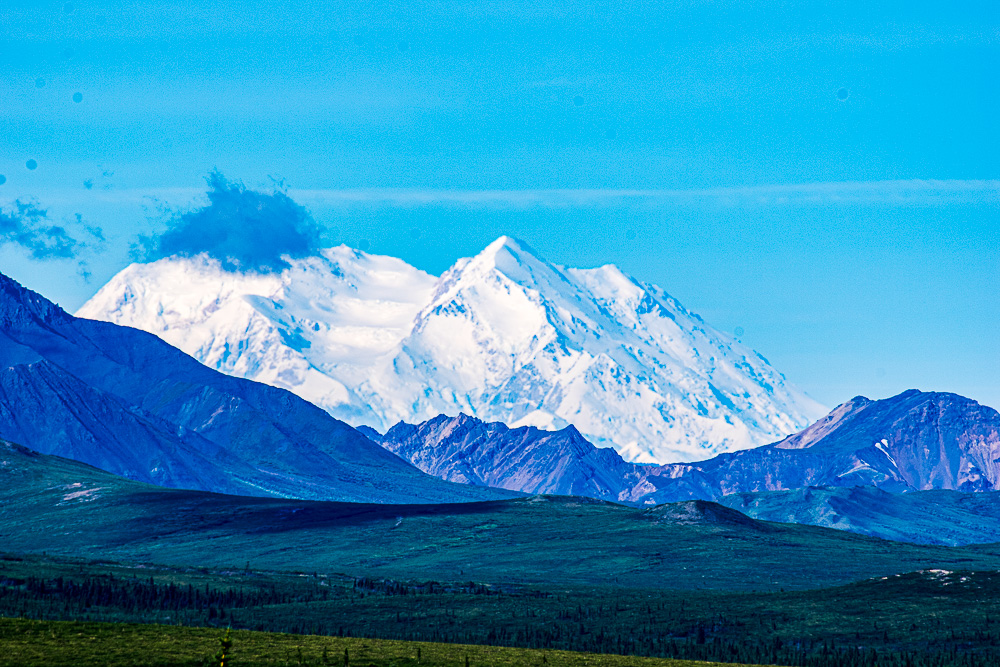

Stunning Views of the Alaska Range
We spent a week in Denali National Park, two nights in Riley Creek Campground and five in Teklanika Campground further inside the park. On the way there from Fairbanks we passed through an area north of Healy that had been experiencing periodic road closures due to wildfire activity in the area in the days before we came through, so we weren’t sure if there’d be delays. Fortunately when we went through the road was open to traffic with a pilot car escort for about 15 miles of Alaska Highway 3, the Parks Highway, through the fire damaged area.

We started our stay with two days in Riley Creek Campground, near the entrance to the park and its main visitor center. It’s a nice National Park campground with no hookups but a dump station with potable water as well as showers and a small store. Riley Creek’s location gives easy access to the bus system and the main village and is also a short drive from the stores and restaurant located on the highway just outside the park.

One of our more memorable experiences in Denali was the ranger-led sled dog demonstrations. As with all ranger talks we’ve attended, this was an interesting dive into the role of sled dogs in the history and current operation of the park.

On to Teklanika Campground

Teklanika Campground is the furthest RV-accessible campground in the park, located 29 miles from the entrance. Because the entrance road is only open to private vehicles up to mile 15, you need a permit to drive to it. That permit is good for one trip in and one trip out to Teklanika. There’s no driving of private vehicles allowed other than that while you’re camped at Tek. You need to purchase a “Tek pass” for the transit busses which basically allows you to ride the green camper busses to move around within the park during your stay. The busses are pretty reliable and come about every half your. Sometimes they’re full and sometimes not but they’ll get you where you need to go. The drivers are really good about pointing out features of the park and stopping for wildlife viewing. Teklanika has potable water but no dump station.

Caribou, Sheep and Bears!
Denali is loaded with wildlife and we got to see quite a bit of it. While walking along the park road we spotted a grizzly bear a couple of hundred yards away. It disappeared into the brush and after a few minutes waiting for it to reappear a caribou came trotting up the road, veered into the brush toward a snowfield and headed straight toward where the bear was. That seemed to get the bear’s attention as it watched the caribou run by. Amazing!


We also got to watch a herd of Dall sheep on Igloo Mountain, one of whom came down from his perch to come within about 25 yards of us.

Learning How to Hike Denali
Most of the marked trails in Denali are located in the first 15 miles of the 90-mile long Park Road, the main road into the park and are typical of the trails in any other park. Outside of that area for the most part you need to plan and follow your own off-trail route, which is a bit of a challenge if you haven’t done it before. In some places you can find remnants of trails (Some of them appear on our GPS maps.) but they frequently run out after a bit.


Denali Park Road Closed at Mile 43
We knew about it going in, but the main road into the park is currently closed at mile 43, just under halfway to the end, so some of the most popular attractions are inaccessible. It’s been closed for the past few years to deal with melting permafrost that caused a landslide, damaging the road. A nearly 500 foot long bridge is being constructed to bypass the damaged section and is expected to open for the 2027 season.You can see more on the progress of the repair here.




Leave a Reply